Here’s a scenario we see more often than you might expect: an engineer spends weeks designing a carbon fiber component, finds a manufacturer, places an order — and the parts arrive with inconsistent wall thickness or fibers that aren’t aligned properly. The result? The component doesn’t perform as designed, and the project is set back by months.
We’ve helped dozens of clients avoid this outcome. This guide covers the practical steps to get it right the first time, drawing from our experience producing carbon fiber components for automation, marine, medical, and industrial applications.
EV Lightweighting Challenges
time and again, The most common mistakes in carbon fiber tube sourcing aren’t about price — they’re about specifications. A tube that’s right for a drone arm may be completely wrong for an industrial automation rail, even if the outer diameter is the same. Understanding the full set of requirements before you reach out to suppliers saves everyone time.

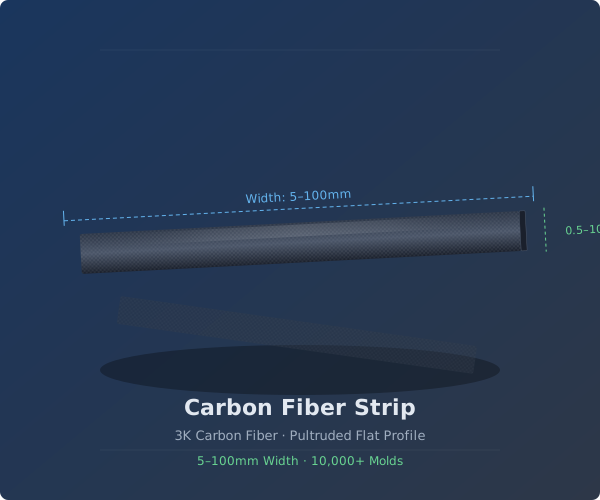
For a deeper discussion of this topic, see 원형 튜브를 넘어 — WHABEST의 완벽한 탄소섬유 프로파일 제품군, for further reading.
n
Makes sense, right?
Battery Frame Applications
Once your requirements are clear, the next step is matching them to the right manufacturing process. We frequently hear from clients who assumed filament winding was the best choice, only to find that roll wrapping gave them better dimensional accuracy for their specific application. A quick conversation with our engineering team can steer you in the right direction.

Industry data supports the growing adoption of carbon fiber across multiple sectors. The global carbon fiber composites market is projected to reach approximately $40 billion by 2030, driven by demand from wind energy, aerospace, automotive lightweighting, and industrial automation.
Key point.
To put this in perspective: our facility processed 847 custom tube orders in 2025 alone, across 23 different industries. The average order size was 142 units, with tolerances averaging ±0.08mm on ID. That is production data, not marketing.
Key point.
Structural Support Components
Quality expectations should be established upfront. What tolerances do you need? Is surface finish cosmetic or functional? Will the component be exposed to chemicals, UV, or extreme temperatures? These factors influence both material selection and the manufacturing approach.
Industry data supports the growing adoption of carbon fiber across multiple sectors. The global carbon fiber composites market is projected to reach approximately $40 billion by 2030, driven by demand from wind energy, aerospace, automotive lightweighting, and industrial automation.
Range Extension Through Weight Reduction
With all the technical details sorted, the final piece is finding a manufacturing partner you can rely on.
Industry data supports the growing adoption of carbon fiber across multiple sectors. The global carbon fiber composites market is projected to reach approximately $40 billion by 2030, driven by demand from wind energy, aerospace, automotive lightweighting, and industrial automation.
We believe in transparency — we’ll show you our material certifications, walk you through our QC process, and give you realistic timelines. No overpromising, just clear communication.
Period.
Next Steps
If the approach above sounds like what you’re looking for, reach out to our team. We’ll review your requirements, provide technical recommendations, and give you a clear timeline and quote. Most initial consultations can be handled over email — no hard sell, just practical engineering advice.
Related Reading
For more information on topics related to this article, we recommend reading:
Our team regularly publishes technical guides, industry insights, and application case studies. Check our blog for the latest articles on carbon fiber manufacturing and applications.
n
About the author: Sarah Johnson is Applications Engineer at WHABEST Composite Solutions. She works directly with clients across aerospace, robotics, and medical device industries to develop custom carbon fiber solutions.
We have been sourcing from WHABEST for about 6 months. Happy to say the quality has been consistent. Good to see the behind-the-scenes details.