We get asked about this comparison regularly.
Engineers and buyers want a straightforward answer: which option is better for their specific application? The honest answer, as you might expect, is that it depends. But let’s break down the decision factors in a practical way.
Semiconductor Manufacturing Challenges
honestly?, Starting with the fundamentals, here’s what each option brings to the table. The differences start with the manufacturing process and ripple through to the final product’s mechanical properties, dimensional accuracy, and cost profile.

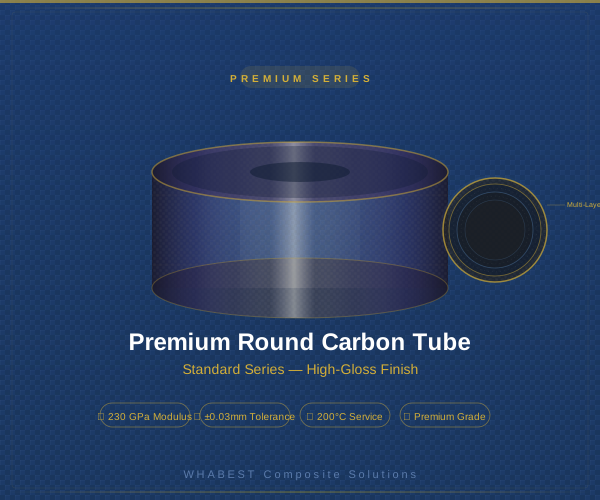
Carbon fiber tubes demonstrate a strength-to-weight ratio approximately 10 times higher than steel and 5 times higher than aluminum. This translates into significant design flexibility — engineers can achieve equivalent structural performance with substantially less weight.
We track scrap rates religiously. In Q1 2026, our overall scrap rate was 2.8%. For comparison, the industry average hovers around 5-7%. The difference? It comes down to process control — monitoring every variable, every batch, every shift.
Easy to overlook.
But here is the thing.

Wafer Handling Applications
One aspect that doesn’t always get enough attention is how the choice affects your supply chain. A process that’s ideal for prototyping may not scale efficiently to production volumes. Conversely, a process optimized for high volume has minimum order quantities that are incompatible with early-stage development.
In practice, this means taking a close look at the specific requirements of your application before making any decisions. The engineering team at WHABEST regularly reviews client specifications and finds that the most successful projects are those where the requirements are clearly defined from the outset.
In practice, this means taking a close look at the specific requirements of your application before making any decisions. The engineering team at WHABEST regularly reviews client specifications and finds that the most successful projects are those where the requirements are clearly defined from the outset.
Cleanroom Compatibility
From a cost perspective, the key variable is typically volume. For low-volume production (under 100 units), processes with low setup costs are preferable. For medium to high volumes, the efficiency of continuous processes like pultrusion becomes increasingly attractive.
And that matters.
Precision and Thermal Stability
Our recommendation: start with your application requirements, then work backward to the process.
Define your must-haves (strength, tolerance, surface finish, volume, timeline) and let those drive the decision. We’re happy to guide you through this process.
Something to think about.
About the author: Chen Ming is Production Supervisor at WHABEST Composite Solutions. With a background in mechanical engineering and 12 years on the workshop floor, he brings practical manufacturing insights to every article.
We have been sourcing from WHABEST for about 6 months. Happy to say the quality has been consistent. Good to see the behind-the-scenes details.