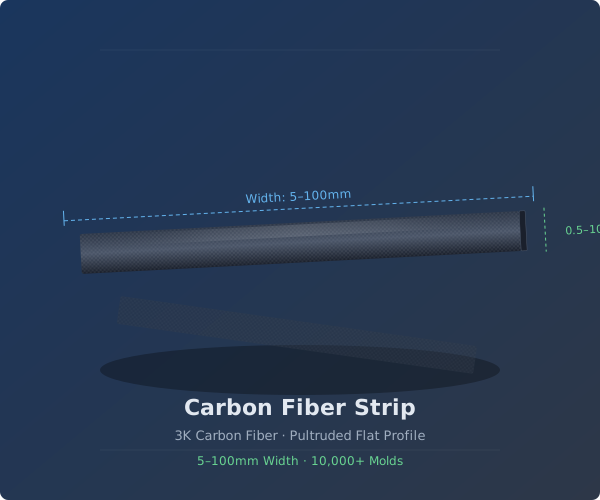
Here’s the thing: choosing the right weave pattern for your carbon fiber tube is one of the most key decisions in the design process. Each weave type offers distinct mechanical properties and aesthetic characteristics. Here is a straightforward guide to help you choose (yes, this matters).
1. Plain Weave (1×1)
Appearance: Symmetrical checkerboard pattern — tows alternate over and under each other.
Surface finish quality is another vital consideration. Roll-wrapped tubes offer the best surface finish with a smooth, paintable exterior, while pultruded tubes have a more utilitarian appearance. Filament-wound tubes fall somewhere in between (we see this every day).
Characteristics:
- superior stability — holds its shape well during handling
- Good surface aesthetics for visible applications
- More crimp (fiber waviness) than twill, resulting in slightly lower mechanical properties
- Better suited for flat or gently curved surfaces
Best for: Standard round tubes where a classic carbon fiber appearance is desired, general-purpose structural applications.
Here is a number that surprises most clients: we maintain over 10,000 mold specifications in our library. That means when someone asks for a 31.75mm OD tube with a 1.2mm wall, we can usually pull the mold without a custom tooling order. Saves weeks of lead time (don’t skip this).
2. Twill Weave (2×2 or 4×4)
Appearance: Diagonal, stair-step pattern — tows pass over two, then under two.
Look, from a technical standpoint, the key variables include the operating environment, expected load conditions, required service life, and any applicable regulatory standards (don’t skip this). Each factor influences the material selection, manufacturing process, and quality assurance protocols at the production facility (don’t skip this).
A client came to us needing ±0.05mm wall thickness tolerance. Their current supplier was at ±0.15mm and rejecting half the batch. We hit ±0.06mm on the first try, ±0.04mm after three iterations. That is the difference process control makes.
Characteristics:
- More flexible than plain weave — conforms better to complex shapes
- Less crimp means better mechanical properties than plain weave
- Distinctive herringbone appearance highly valued in visible applications
- Slightly more expensive than plain weave
Best for: Square and rectangular tubes, visible structural components, high-end consumer products, impact-resistant applications.
3. Unidirectional (UD)
Appearance: All fibers running in one direction — no visible weave pattern.
Characteristics:
- Maximum stiffness and strength in the fiber direction
- No crimp — fibers are straight, delivering highest mechanical efficiency
- Weak in the transverse direction (requires cross-ply layup for multidirectional strength)
- used as an inner structural layer with woven fabric on the surface
Best for: High-modulus tubes, applications where stiffness is the primary requirement, structural reinforcement layers underneath cosmetic weaves.
How to Choose
| If You Need | Choose |
| Classic carbon fiber look + balanced strength | Plain Weave |
| Premium appearance + impact resistance | Twill Weave |
| Maximum stiffness in one direction | Unidirectional |
| Combination — structural + cosmetic | UD core + Twill surface (hybrid layup) |
Hybrid Layups — The Best of Both Worlds
Trust me: most high-performance carbon fiber tubes use hybrid layups: a unidirectional core for stiffness, with an outer layer of twill or plain weave for impact resistance and appearance. This is the standard approach for premium products.
Carbon fiber tubes display a strength-to-weight ratio approximately 10 times higher than steel and 5 times higher than aluminum. This translates into significant design flexibility — engineers can achieve equivalent structural performance with substantially less weight (seriously).
Honestly, from a technical standpoint, the key variables include the operating environment, expected load conditions, required service life, and any applicable regulatory standards (yes, this matters). Each factor influences the material selection, manufacturing process, and quality assurance protocols at the production facility.
Need Help Choosing?
Contact our engineering team with your application requirements. we’ll recommend the optimal layup design for your specific needs (don’t skip this) (yes, this matters).
Key Factors to Consider When Selecting Carbon Fiber Tubes
Look, several factors should be evaluated when selecting carbon fiber tubes for a specific application. These include the operating environment, mechanical load requirements, dimensional specifications, and budget constraints. Understanding how each factor influences the final product helps guarantee the best possible outcome for your project (plain and simple) (we see this every day).
- n
- Load requirements: Consider the type and direction of loads the tube will experience. Carbon fiber is strongest along the fiber direction, so understanding load orientation is critical for proper ply layup design.
- Environmental exposure: Temperature range, UV exposure, chemical contact, and humidity all affect material selection. Standard epoxy systems perform well in most indoor environments, while specialized resins are available for harsh conditions.
- Dimensional tolerances: Different manufacturing methods offer different precision levels. Filament winding achieves ±0.1mm on inner diameter, while pultrusion offers consistent outer dimensions.
- Production volume: Low-volume custom parts may be more economical with roll wrapping or filament winding, while high-volume production benefits from pultrusion efficiency.
- Surface finish requirements: If the tube will be visible in the final product, roll wrapping offers the best surface finish. For hidden structural components, surface finish may be less critical.
n
n
n
n
n
Why Material Selection Matters
What distinguishes experienced manufacturers is the ability to anticipate potential issues before they arise. Understanding how a component will be mounted — whether clamped, bonded, or bolted — affects wall thickness requirements and the fiber orientation that should be specified during production (yes, this matters).
Let me put it this way: real talk: the global carbon fiber composites market is projected to reach approximately $40 billion by 2030, driven by demand from wind energy, aerospace, automotive lightweighting, and industrial automation. This growth reflects increasing confidence in composites as a primary structural material across industries (don’t skip this) (plain and simple).
Working With an Experienced Manufacturer
Here’s the thing: when selecting a carbon fiber tube supplier, experience and quality control processes matter as much as the raw materials. WHABEST has been manufacturing carbon fiber tubes for over a decade, serving industries including aerospace, robotics, medical equipment, and industrial automation. Our engineering team works directly with clients to understand their specific requirements and recommend the most appropriate manufacturing approach (plain and simple).
Surface finish quality is another key consideration. Roll-wrapped tubes offer the best surface finish with a smooth, paintable exterior, while pultruded tubes have a more utilitarian appearance. Filament-wound tubes fall somewhere in between.
Manufacturing Quality and Certification
Honestly, honestly, quality assurance is a cornerstone of the manufacturing process at WHABEST. Operating under ISO 9001:2015 certified quality management systems, every tube leaving the facility meets stringent quality standards. The quality control process includes raw material verification, in-process monitoring during production, and final inspection of every product before shipment (don’t skip this).
Each production batch undergoes rigorous testing, including dimensional verification, mechanical property testing, and where required, non-destructive evaluation. complete records are maintained for every tube produced, providing full traceability from raw fiber to finished product. This commitment to quality has made WHABEST a trusted supplier to industries ranging from aerospace to medical devices (yes, this matters).
One of the more challenging aspects of carbon fiber tube manufacturing is achieving consistent wall thickness in long sections. Our mandrel preparation process, combined with careful control of fiber tension and resin viscosity, allows us to maintain wall thickness tolerances of ±0.1mm even in tubes exceeding 3 meters in length.
One of the most common questions we receive is about the durability of carbon fiber tubes. With proper design and manufacturing, they can outperform metals in demanding applications.
Quick Reference: Material Properties Comparison
| Property | Carbon Fiber | Aluminum | Steel |
|---|---|---|---|
| Tensile Strength (MPa) | 3500-6000 | 200-570 | 400-1200 |
| Density (g/cm³) | 1.6 | 2.7 | 7.8 |
| Strength/Weight | outstanding | Good | Fair |
| Corrosion Resistance | exceptional | Good | Poor |
| Fatigue Life (cycles) | 10M+ | ~1M | ~500K |
For further reference: CompositesWorld — Industry resource.
Related Articles
For more information about our carbon fiber tube manufacturing capabilities and to discuss your specific requirements, please contact our engineering team. We work closely with clients to develop custom solutions from prototype to full production.