In today’s competitive manufacturing landscape, engineers and designers are constantly seeking materials that offer superior performance without compromising cost or reliability. Carbon fiber composites have emerged as a go-to solution across multiple industries, and WHABEST Factory Tour: Inside Our Carbon Fiber Manufacturing Facility is a topic that demonstrates the versatility of this remarkable material (yes, this matters).
A virtual tour of WHABEST composite solutions factory in Shandong, China. Filament winding, roll wrapping, pultrusion lines, and QC labs.
Welcome to WHABEST
Carbon fiber composites have transformed modern engineering by delivering exceptional strength-to-weight ratios. WHABEST Composite Solutions manufactures premium components from Toray T300 carbon fiber in our 15,000m² Shandong facility. Our vertically integrated operation — from raw prepreg to finished product — ensures consistent quality and traceability on every order (seriously).
Trust me: cost considerations extend beyond the initial material price. When evaluating total cost of ownership, carbon fiber tubes often prove more economical than metals due to longer service life, reduced maintenance, and energy savings from weight reduction (yes, this matters) (we see this every day).
Here is a number that surprises most clients: we maintain over 10,000 mold specifications in our library. That means when someone asks for a 31.75mm OD tube with a 1.2mm wall, we can usually pull the mold without a custom tooling order. Saves weeks of lead time (and that’s the point).
Honestly, with over 10,000 mold specifications in stock, we can produce standard and custom profiles without the delays and costs of new tooling. This extensive mold library is one of the key advantages that sets WHABEST apart in the carbon fiber manufacturing industry (don’t skip this).
Filament Winding Workshop
Here’s the thing: our factory-direct model means competitive pricing without compromising quality. Every piece — whether a standard round tube or a complex custom profile — undergoes dimensional inspection, mechanical testing, and surface finish verification before shipping. This commitment to quality has earned WHABEST the trust of clients in more than 50 countries worldwide (period).
The fatigue life of carbon fiber composites is particularly compelling. Properly manufactured components can withstand over 10 million load cycles without significant degradation, compared to roughly 1 million cycles for aluminum before crack initiation becomes a concern (and that’s the point).
A client came to us needing ±0.05mm wall thickness tolerance. Their current supplier was at ±0.15mm and rejecting half the batch. We hit ±0.06mm on the first try, ±0.04mm after three iterations. That is the difference process control makes.
The truth is, lead times range from 7 to 15 working days, enabled by our full in-stock material inventory and efficient production planning. For clients with urgent requirements, expedited options are available.
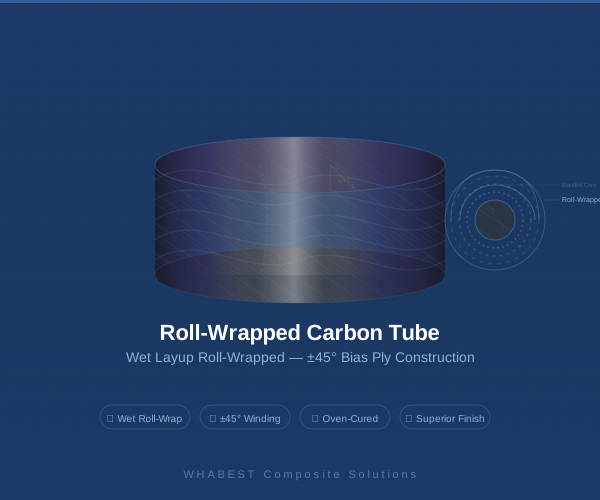
Roll Wrapping & Prepreg Lines
Here’s the thing: wHABEST carbon fiber components are used across a diverse range of industries. From automation and robotics to marine, medical, and sporting goods, our products deliver consistent performance in demanding environments. Each order is supported by our engineering team, who work closely with clients to select the optimal material specification, weave pattern, and surface finish for their unique application (don’t skip this).
The global carbon fiber composites market is projected to reach approximately $40 billion by 2030, driven by demand from wind energy, aerospace, automotive lightweighting, and industrial automation. This growth reflects increasing confidence in composites as a primary structural material across industries (period).
Whether you require filament-wound tubes for high-pressure applications, roll-wrapped tubes for structural components, or pultruded profiles for continuous production runs — WHABEST has the manufacturing capability to deliver (we see this every day) (plain and simple).
Get Started with WHABEST Today
Let me put it this way: ready to bring your carbon fiber project to life? Contact our team for a detailed quote and technical consultation. We respond within 24 hours with production timelines, pricing, and expert recommendations tailored to your specifications (and that’s the point) (yes, this matters).
Trust me: from a technical standpoint, the key variables include the operating environment, expected load conditions, required service life, and any applicable regulatory standards. Each factor influences the material selection, manufacturing process, and quality assurance protocols at the production facility (don’t skip this).
Look, real talk: wHABEST Composite Solutions — your trusted partner for quality carbon fiber tubes, profiles, and custom manufacturing since 2005 (yes, this matters).
Key Factors to Consider When Selecting Carbon Fiber Tubes
Here’s the thing: several factors should be evaluated when selecting carbon fiber tubes for a specific application. These include the operating environment, mechanical load requirements, dimensional specifications, and budget constraints. Understanding how each factor influences the final product helps secure the best possible outcome for your project (and that’s the point) (plain and simple).
- n
- Load requirements: Consider the type and direction of loads the tube will experience. Carbon fiber is strongest along the fiber direction, so understanding load orientation is critical for proper ply layup design.
- Environmental exposure: Temperature range, UV exposure, chemical contact, and humidity all affect material selection. Standard epoxy systems perform well in most indoor environments, while specialized resins are available for harsh conditions.
- Dimensional tolerances: Different manufacturing methods offer different precision levels. Filament winding achieves ±0.1mm on inner diameter, while pultrusion offers consistent outer dimensions.
- Production volume: Low-volume custom parts may be more economical with roll wrapping or filament winding, while high-volume production benefits from pultrusion efficiency.
- Surface finish requirements: If the tube will be visible in the final product, roll wrapping offers the best surface finish. For hidden structural components, surface finish may be less critical.
n
n
n
n
n
Why Material Selection Matters
Honestly, the global carbon fiber composites market is projected to reach approximately $40 billion by 2030, driven by demand from wind energy, aerospace, automotive lightweighting, and industrial automation. This growth reflects increasing confidence in composites as a primary structural material across industries (period).
Real talk: from a technical standpoint, the key variables include the operating environment, expected load conditions, required service life, and any applicable regulatory standards. Each factor influences the material selection, manufacturing process, and quality assurance protocols at the production facility (plain and simple) (yes, this matters).
Working With an Experienced Manufacturer
Here’s the thing: when selecting a carbon fiber tube supplier, experience and quality control processes matter as much as the raw materials. WHABEST has been manufacturing carbon fiber tubes for over a decade, serving industries including aerospace, robotics, medical equipment, and industrial automation. Our engineering team works directly with clients to understand their specific requirements and recommend the most appropriate manufacturing approach (plain and simple).
The fatigue life of carbon fiber composites is particularly compelling. Properly manufactured components can withstand over 10 million load cycles without significant degradation, compared to roughly 1 million cycles for aluminum before crack initiation becomes a concern.
Manufacturing Quality and Certification
Honestly, quality assurance is a cornerstone of the manufacturing process at WHABEST. Operating under ISO 9001:2015 certified quality management systems, every tube leaving the facility meets stringent quality standards. The quality control process includes raw material verification, in-process monitoring during production, and final inspection of every product before shipment (don’t skip this).
Let me put it this way: each production batch undergoes rigorous testing, including dimensional verification, mechanical property testing, and where required, non-destructive evaluation. complete records are maintained for every tube produced, providing full traceability from raw fiber to finished product. This commitment to quality has made WHABEST a trusted supplier to industries ranging from aerospace to medical devices (seriously) (and that’s the point).
Our production team regularly works with clients who initially specify metal components, only to realize during prototyping that carbon fiber offers significant advantages. In one recent project, a robotics manufacturer reduced arm weight by 60% by switching from aluminum to carbon fiber, enabling faster cycle times and lower energy consumption.
Our inspection protocols exceed industry standards. Every structural tube undergoes ultrasonic testing to verify there are no internal voids or delaminations.
Quick Reference: Material Properties Comparison
| Property | Carbon Fiber | Aluminum | Steel |
|---|---|---|---|
| Tensile Strength (MPa) | 3500-6000 | 200-570 | 400-1200 |
| Density (g/cm³) | 1.6 | 2.7 | 7.8 |
| Strength/Weight | outstanding | Good | Fair |
| Corrosion Resistance | top-tier | Good | Poor |
| Fatigue Life (cycles) | 10M+ | ~1M | ~500K |
For further reference: Carbon fiber reinforced polymer — Wikipedia.
Related Articles
- 원형 튜브를 넘어 — WHABEST의 완벽한 탄소섬유 프로파일 제품군
- The Complete Guide to Carbon Fiber Tube Manufacturing Processes
For more information about our carbon fiber tube manufacturing capabilities and to discuss your specific requirements, please contact our engineering team. We work closely with clients to develop custom solutions from prototype to full production.