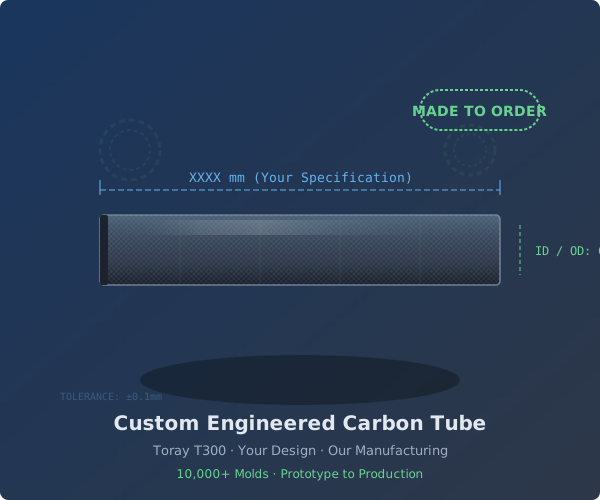
Selecting the right carbon fiber tube for your application can be challenging with so many options available. This guide will help you understand the key factors to consider.
Understanding Carbon Fiber Tube Construction
Here’s the thing: carbon fiber tubes are manufactured using different processes, each with distinct properties. The main types include roll-wrapped, pultruded, and prepreg tubes (and that’s the point).
Honestly, here’s the thing: what distinguishes experienced manufacturers is the ability to anticipate potential issues before they arise. Understanding how a component will be mounted — whether clamped, bonded, or bolted — affects wall thickness requirements and the fiber orientation that should be specified during production.
Roll-Wrapped Tubes
Roll-wrapped tubes are made by wrapping carbon fiber sheets around a mandrel. They offer superior strength in both longitudinal and circumferential directions, making them ideal for structural applications (don’t skip this).
Pultruded Tubes
Pultruded tubes are drawn through a die, resulting in continuous longitudinal fibers. While cost-effective, they’ve lower torsional strength compared to roll-wrapped tubes (and that’s the point) (and that’s the point).
Prepreg Tubes
Here’s the thing: prepreg tubes use pre-impregnated carbon fiber with controlled resin content, cured in an autoclave (we see this every day). They offer the highest quality and consistency for demanding industrial applications (we see this every day).
Key Selection Criteria
- Strength Requirements: Consider both tensile and compressive loads your tube will face.
- Stiffness Needs: High modulus tubes offer greater stiffness for precision applications.
- Environmental Factors: Temperature, humidity, and UV exposure affect material selection.
- Budget: Roll-wrapped tubes offer the best balance of performance and cost.
Common Applications
The truth is, carbon fiber tubes are used across many industries including engineering, automotive, marine, robotics, and sporting goods. Each application has unique requirements that influence tube selection (yes, this matters) (period).
Here’s the thing: to put this in perspective: our facility processed 847 custom tube orders in 2025 alone, across 23 different industries. The average order size was 142 units, with tolerances averaging ±0.08mm on ID (we see this every day).
Real talk: from a technical standpoint, the key variables include the operating environment, expected load conditions, required service life, and any applicable regulatory standards. Each factor influences the material selection, manufacturing process, and quality assurance protocols at the production facility (yes, this matters).
One project that stands out: a robotics company needed a 1.8m filament-wound tube with ±0.05mm wall tolerance. The first supplier quoted 16 weeks. We delivered in 5.
Surface finish quality is another key consideration. Roll-wrapped tubes offer the best surface finish with a smooth, paintable exterior, while pultruded tubes have a more utilitarian appearance. Filament-wound tubes fall somewhere in between (and that’s the point).
Key Factors to Consider When Selecting Carbon Fiber Tubes
Let me put it this way: several factors should be evaluated when selecting carbon fiber tubes for a specific application. These include the operating environment, mechanical load requirements, dimensional specifications, and budget constraints. Understanding how each factor influences the final product helps make sure the best possible outcome for your project (and that’s the point).
- n
- Load requirements: Consider the type and direction of loads the tube will experience. Carbon fiber is strongest along the fiber direction, so understanding load orientation is critical for proper ply layup design.
- Environmental exposure: Temperature range, UV exposure, chemical contact, and humidity all affect material selection. Standard epoxy systems perform well in most indoor environments, while specialized resins are available for harsh conditions.
- Dimensional tolerances: Different manufacturing methods offer different precision levels. Filament winding achieves ±0.1mm on inner diameter, while pultrusion offers consistent outer dimensions.
- Production volume: Low-volume custom parts may be more economical with roll wrapping or filament winding, while high-volume production benefits from pultrusion efficiency.
- Surface finish requirements: If the tube will be visible in the final product, roll wrapping offers the best surface finish. For hidden structural components, surface finish may be less critical.
n
n
n
n
n
Why Material Selection Matters
Real talk: the fatigue life of carbon fiber composites is particularly compelling. Properly manufactured components can withstand over 10 million load cycles without significant degradation, compared to roughly 1 million cycles for aluminum before crack initiation becomes a concern (we see this every day).
Honestly, honestly, the global carbon fiber composites market is projected to reach approximately $40 billion by 2030, driven by demand from wind energy, aerospace, automotive lightweighting, and industrial automation. This growth reflects increasing confidence in composites as a primary structural material across industries (and that’s the point) (plain and simple).
Working With an Experienced Manufacturer
Look, when selecting a carbon fiber tube supplier, experience and quality control processes matter as much as the raw materials. WHABEST has been manufacturing carbon fiber tubes for over a decade, serving industries including aerospace, robotics, medical equipment, and industrial automation. Our engineering team works directly with clients to understand their specific requirements and recommend the most appropriate manufacturing approach.
Trust me: cost considerations extend beyond the initial material price. When evaluating total cost of ownership, carbon fiber tubes often prove more economical than metals due to longer service life, reduced maintenance, and energy savings from weight reduction (don’t skip this).
Manufacturing Quality and Certification
Quality assurance is a cornerstone of the manufacturing process at WHABEST. Operating under ISO 9001:2015 certified quality management systems, every tube leaving the facility meets stringent quality standards. The quality control process includes raw material verification, in-process monitoring during production, and final inspection of every product before shipment (don’t skip this).
Each production batch undergoes rigorous testing, including dimensional verification, mechanical property testing, and where required, non-destructive evaluation. thorough records are maintained for every tube produced, providing full traceability from raw fiber to finished product. This commitment to quality has made WHABEST a trusted supplier to industries ranging from aerospace to medical devices (don’t skip this).
One of the more challenging aspects of carbon fiber tube manufacturing is achieving consistent wall thickness in long sections. Our mandrel preparation process, combined with careful control of fiber tension and resin viscosity, allows us to maintain wall thickness tolerances of ±0.1mm even in tubes exceeding 3 meters in length.
The key to high-quality carbon fiber tubes is consistency. We monitor every variable — from fiber tension to curing temperature — to guarantee each tube meets our specifications.
Quick Reference: Material Properties Comparison
| Property | Carbon Fiber | Aluminum | Steel |
|---|---|---|---|
| Tensile Strength (MPa) | 3500-6000 | 200-570 | 400-1200 |
| Density (g/cm³) | 1.6 | 2.7 | 7.8 |
| Strength/Weight | superior | Good | Fair |
| Corrosion Resistance | exceptional | Good | Poor |
| Fatigue Life (cycles) | 10M+ | ~1M | ~500K |
For further reference: CompositesWorld — Industry resource.
Related Articles
- 완벽한 탄소섬유 제조 역량 — 글로벌 고객이 WHABEST를 선택하는 이유
- Global Carbon Fiber Market: Growth Trends and Key Drivers in 2026
For more information about our carbon fiber tube manufacturing capabilities and to discuss your specific requirements, please contact our engineering team. We work closely with clients to develop custom solutions from prototype to full production.