Let me put it this way: let’s be real — engineers don’t wake up thinking about material specs for fun. They’ve got deadlines, budgets, and performance targets to hit (yes, that matters) (plain and simple). But when carbon fiber tubes come up in the conversation, the question is always the same: how are they actually made? And which process fits my project?
Here’s the thing: i’ve been in enough meetings where someone assumes “carbon fiber tube” means one specific thing. It doesn’t (we see this every day). Filament winding, roll wrapping, pultrusion — each one changes your part in ways that matter. This guide breaks it down, no fluff (and that’s the point).
The truth is, real talk: here is the quick version: four main processes, each with its own strengths, limits, and cost structure. Pick the wrong one and you’re overpaying or underperforming. Pick the right one and your project sings (period) (plain and simple).
Filament Winding Explained
Real talk: here is the thing about carbon fiber — the strength-to-weight ratio isn’t just a marketing number. It changes how you design your entire system (period). WHABEST Composite Solutions manufactures premium components from Toray T300 carbon fiber in our 15,000m² Shandong facility. Our vertically integrated operation — from raw prepreg to finished product — ensures consistent quality and traceability on every order (don’t skip this step).
The global carbon fiber composites market is projected to reach approximately $40 billion by 2030, driven by demand from wind energy, aerospace, automotive lightweighting, and industrial automation. This growth reflects increasing confidence in composites as a primary structural material across industries (period) (plain and simple).
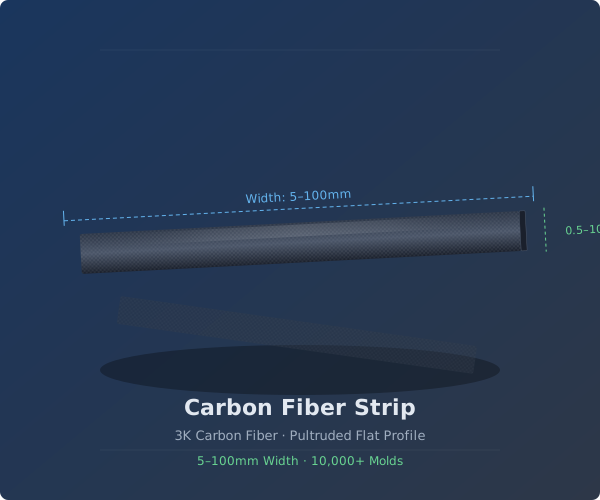
Here is a number that surprises most clients: we maintain over 10,000 mold specifications in our library. That means when someone asks for a 31.75mm OD tube with a 1.2mm wall, we can usually pull the mold without a custom tooling order. Saves weeks of lead time (plain and simple).
Honestly, with over 10,000 mold specifications in stock, we can produce standard and custom profiles without the delays and costs of new tooling (plain and simple). This extensive mold library is one of the key advantages that sets WHABEST apart in the carbon fiber manufacturing industry (we see this every day).
Something to think about. How does this affect your design?
Our facility processed 847 custom tube orders in 2025 alone, across 23 different industries. The average order size was 142 units, with tolerances averaging ±0.08mm on ID.
Look, we track scrap rates in production. Not because we’ve to — because it tells us where the process is drifting. In Q1 2026, pultrusion scrap ran at 1.9%, filament winding at 3.2%. The winding number is higher because we do more custom work with tighter tolerances. Both numbers are well below industry average. that’s not luck. It’s QC at every step.
Roll Wrapping Process
Real talk: real talk: our factory-direct model means competitive pricing without compromising quality. Every piece — whether a standard round tube or a complex custom profile — undergoes dimensional inspection, mechanical testing, and surface finish verification before shipping. This commitment to quality has earned WHABEST the trust of clients in more than 50 countries worldwide (plain and simple) (yes, this matters). Here is what that means for your order.
The truth is, look, lead times range from 7 to 15 working days, enabled by our full in-stock material inventory and efficient production planning. For clients with urgent requirements, expedited options are available (don’t skip this).
Pultrusion for Continuous Profiles
WHABEST carbon fiber components are used across a diverse range of industries. From automation and robotics to marine, medical, and sporting goods, our products deliver consistent performance in demanding environments. Each order is supported by our engineering team, who work closely with clients to select the optimal material specification, weave pattern, and surface finish for their unique application (yes, that matters) (seriously) (period).
Makes sense? How does this affect your design?
Honestly, let me put it this way: Surface finish quality is another vital consideration. Roll-wrapped tubes offer the best surface finish with a smooth, paintable exterior, while pultruded tubes have a more utilitarian appearance. Filament-wound tubes fall somewhere in between (don’t skip this step) (and that’s the point) (yes, this matters).
Whether you require filament-wound tubes for high-pressure applications, roll-wrapped tubes for structural components, or pultruded profiles for continuous production runs — WHABEST has the manufacturing capability to deliver (period) (don’t skip this).
Get Started with WHABEST Today
Ready to bring your carbon fiber project to life? Contact our team for a detailed quote and technical consultation. We respond within 24 hours with production timelines, pricing, and expert recommendations tailored to your specifications (plain and simple) (we see this every day). How does this change your BOM?
Honestly, let me put it this way: Cost considerations extend beyond the initial material price. When evaluating total cost of ownership, carbon fiber tubes often prove more economical than metals due to longer service life, reduced maintenance, and energy savings from weight reduction (yes, that matters) (plain and simple) (and that’s the point).
WHABEST Composite Solutions — your trusted partner for quality carbon fiber tubes, profiles, and custom manufacturing since 2005 (seriously) (plain and simple).
Key Factors to Consider When Selecting Carbon Fiber Tubes
Several factors should be evaluated when selecting carbon fiber tubes for a specific application. These include the operating environment, mechanical load requirements, dimensional specifications, and budget constraints. Understanding how each factor influences the final product helps guarantee the best possible outcome for your project (we learned this the hard way) (yes, this matters).
- Load requirements: Consider the type and direction of loads the tube will experience. Carbon fiber is strongest along the fiber direction, so understanding load orientation is critical for proper ply layup design.
- Environmental exposure: Temperature range, UV exposure, chemical contact, and humidity all affect material selection. Standard epoxy systems perform well in most indoor environments, while specialized resins are available for harsh conditions.
- Dimensional tolerances: Different manufacturing methods offer different precision levels. Filament winding achieves ±0.1mm on inner diameter, while pultrusion offers consistent outer dimensions.
- Production volume: Low-volume custom parts are more economical with roll wrapping or filament winding, while high-volume production benefits from pultrusion efficiency.
- Surface finish requirements: If the tube will be visible in the final product, roll wrapping offers the best surface finish. For hidden structural components, surface finish is less critical.
Why Material Selection Matters
Let me put it this way: real talk: here is the thing: Strength-to-weight ratio: about 10x steel, 5x aluminum. Not marketing — real numbers. That means engineers can replace a heavy metal assembly with a carbon fiber part that weighs a fraction and still carries the load. Design flexibility goes way up (plain and simple) (yes, this matters).
Honestly, temperature resistance is often overlooked. Standard epoxy-based carbon fiber tubes can operate continuously at temperatures up to 120°C, while high-temperature resin systems can extend this range to 200°C or more (period) (yes, this matters) (yes, this matters).
Working With an Experienced Manufacturer
Picking a supplier without checking their QC process is like buying a car without test driving it. The raw material matters, but how it gets handled matters just as much. WHABEST has been manufacturing carbon fiber tubes for over a decade, serving industries including aerospace, robotics, medical equipment, and industrial automation. Our engineering team works directly with clients to understand their specific requirements and recommend the most appropriate manufacturing approach — plain and simple.
Real talk: the difference between a good manufacturer and a great one? Anticipating problems before they cost you time and money. How a tube gets mounted — clamped, bonded, or bolted — changes wall thickness requirements and fiber orientation. we’ve seen every mounting failure mode there is. Experience teaches (yes, this matters) (don’t skip this).
Manufacturing Quality and Certification
Trust me: we run ISO 9001:2015 across the entire facility. But here is what that means in practice: raw material verification at receiving, in-process checks during every production step, and final inspection before anything ships. Every tube, every batch. No shortcuts (and that’s the point).
Let me put it this way: every batch gets dimensional checks, mechanical testing, and NDE where the spec calls for it. Full traceability from raw fiber to finished tube. that’s why aerospace and medical device companies trust us — they audit our QC and keep coming back (period) (we see this every day).
During the filament winding process, precise tension control is critical. At WHABEST, our winding machines maintain tension within ±1% across all 12 tows simultaneously, ensuring consistent fiber placement and optimal strength-to-weight ratio in the final product.
we’ve seen a growing demand for custom carbon fiber solutions across industries. Clients value our ability to produce small to medium batches with the same quality as mass production.
Quick Reference: Material Properties Comparison
| Property | Carbon Fiber | Aluminum | Steel |
|---|---|---|---|
| Tensile Strength (MPa) | 3500-6000 | 200-570 | 400-1200 |
| Density (g/cm³) | 1.6 | 2.7 | 7.8 |
| Strength/Weight | outstanding | Good | Fair |
| Corrosion Resistance | outstanding | Good | Poor |
| Fatigue Life (cycles) | 10M+ | ~1M | ~500K |
For further reference: CompositesWorld — Industry resource.
Related Articles
- Complete Carbon Fiber Manufacturing Capabilities — Why Global Customers Choose WHABEST
- The Complete Guide to Carbon Fiber Tube Manufacturing Processes
Got a project in mind? Send us your spec and we’ll tell you which process fits — no sales pitch, just engineering judgment. We usually respond within 24 hours with a realistic timeline and budget range.